 Ave Audio
Catholic vs Christian: What Is the Difference?

Lifelong Catholic, Knight of Columbus, and founder of Ave Audio. 20+ years in software engineering.
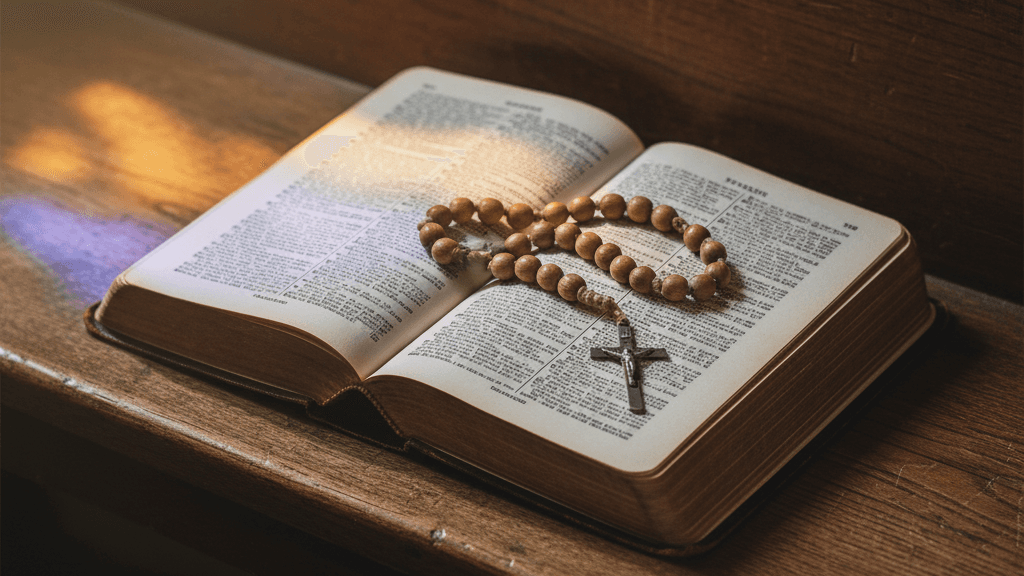
Are Catholics Christian? It is one of the most common questions people ask about the faith, and the short answer is yes — Catholics are Christians, and the Catholic Church is the oldest continuous Christian tradition in the world. But the question keeps getting asked, and for good reason. There are real differences between Catholic teaching and the dozens of other Christian traditions that have emerged over two thousand years. This guide walks through what separates them, what unites them, and why the distinction matters.
Key Takeaways
- All Catholics are Christian, but not all Christians are Catholic
- About 1.3 billion of the world's 2.4 billion Christians are Catholic (Pew Research Center, 2024)
- The main differences involve authority, sacraments, Scripture, and the role of Mary and the saints
- The Catholic-Protestant split began in 1517 with the Reformation
- Pray the Our Father with Ave Audio — the prayer every Christian tradition shares
Are Catholics Christian?
Yes. Catholics are Christians. The word Christian simply means "follower of Christ," and Catholics have followed Jesus as Lord and Savior since the first century. In fact, for the first thousand years of Christianity, there was essentially one church — what Catholics today call the Catholic (meaning "universal") Church. The terms "Catholic" and "Christian" were effectively interchangeable until theological and political divisions later produced other branches.
The confusion usually comes from the modern American context, where many Protestant Christians use "Christian" as a shorthand for their own tradition — particularly evangelical or non-denominational Protestantism. In that usage, "Catholic vs Christian" sounds like two separate things. Globally, though, Catholics make up roughly half of all Christians and remain the largest single Christian body on earth.
Our observation: When someone asks "are Catholics Christian," they are usually asking a deeper question — whether Catholic practice looks different enough from their own experience to count as the same faith. It is a fair question, and it deserves a real answer rather than a defensive one.
What Is the Difference Between Catholic and Christian?
The more precise question is: what is the difference between Catholics and other Christians — particularly Protestants, who make up most of non-Catholic Christianity in the United States. The five biggest differences involve authority, the sacraments, Scripture and tradition, the role of Mary and the saints, and the nature of the Eucharist.
| Topic | Catholic Teaching | Typical Protestant Teaching |
|---|---|---|
| Authority | Pope, bishops, Sacred Tradition, and Scripture | Scripture alone (sola scriptura) |
| Sacraments | Seven: Baptism, Eucharist, Confirmation, Reconciliation, Anointing, Matrimony, Holy Orders | Usually two: Baptism and Communion |
| The Eucharist | The bread and wine become the actual body and blood of Christ (transubstantiation) | Symbolic memorial or spiritual presence |
| Mary and Saints | Venerated, asked to intercede in prayer | Honored historically but not invoked |
| Salvation | Grace through faith, expressed in works and the sacraments | Grace through faith alone (sola fide) |
None of these differences mean Catholics reject Jesus, the Trinity, the Bible, or the core Nicene Creed. In fact, Catholics and most Protestants share the same early creeds, the same New Testament canon (plus or minus seven Old Testament books), and the same basic commitment that Jesus is God the Son who rose from the dead.
How Many Catholics Are There Compared to Other Christians?
There are roughly 2.4 billion Christians in the world, and about 1.3 billion of them are Catholic (Pew Research Center, 2024). That makes Catholicism the largest single Christian tradition on earth by a wide margin — bigger than all Protestant denominations combined, and several times larger than the Eastern Orthodox Church.
In the United States, the picture is more mixed. Protestants still outnumber Catholics overall, but the Catholic Church remains the single largest religious body in the country. About one in five Americans identifies as Catholic, while the Protestant share is split across thousands of denominations and non-denominational congregations.
When Did Catholics and Protestants Split?
The Catholic-Protestant split began on October 31, 1517, when a German monk named Martin Luther posted his 95 Theses on the door of the Castle Church in Wittenberg. Luther was protesting the sale of indulgences and calling for specific reforms — he did not intend to start a new church. But the printing press turned his ideas into a movement, and within a few decades Lutheran, Reformed (Calvinist), and Anglican traditions had broken from Rome.
The Reformation was not just theological. Political rulers in northern Europe saw an opportunity to consolidate power by breaking from the Pope, and wars followed. The Catholic Church responded with its own reform effort — the Counter-Reformation and the Council of Trent (1545-1563) — which clarified Catholic teaching on Scripture, sacraments, and salvation in ways that still define the Catholic side of the divide.
The earlier split, between the Catholic Church and the Eastern Orthodox Church, happened in 1054 and is called the Great Schism. It was driven by disputes over papal authority and a single phrase in the Nicene Creed (the filioque clause). Orthodox and Catholic theology remain closer than either is to Protestant theology on most questions.
What is worth noticing is that the Reformation produced ongoing division — not one split, but thousands. There are now estimated to be over 45,000 Protestant denominations globally, from historic Lutheran and Anglican traditions to newer non-denominational movements. Catholics, by contrast, remain in communion with one another under the Pope. That structural difference is one of the clearest practical distinctions between the two.
Why Do Catholics Pray to Mary and the Saints?
Catholics do not worship Mary or the saints. They ask Mary and the saints to pray for them — which is very different from worshipping them. The technical Catholic word is intercession: asking someone in heaven to bring a prayer before God, the same way a Christian on earth might ask a friend to pray for them.
Catholics believe that people who have died in Christ are still alive in God — "the communion of saints," as the Apostles' Creed puts it. Because they are alive in Christ, Catholics believe they can hear our prayers and pray on our behalf. Mary, as the mother of Jesus, holds a special place in this understanding. Catholics look to her the way a family looks to a trusted mother.
This is why prayers like the Memorare, the Hail Mary, and the Rosary exist. They are not addressed to Mary as God. They ask Mary to pray for the person reciting them. Most Protestants do not invoke Mary or the saints in prayer — not because they reject the people themselves, but because they read Scripture as directing prayer only to God.
According to the Catechism of the Catholic Church (paragraph 2675), Marian prayer "leads to Christ" — the purpose of honoring Mary in Catholic teaching is always to draw closer to her son. This is an important point for understanding Catholic practice rather than caricaturing it.
What About the Eucharist and the Mass?
The Eucharist is where Catholic and Protestant practice looks most different on a Sunday morning. Catholics believe that during the Mass, the bread and wine become the actual body and blood of Jesus Christ. This is called transubstantiation — the substance changes while the appearance stays the same. Receiving the Eucharist is the central act of Catholic worship.
Most Protestant traditions understand communion as a memorial or a spiritual presence, not a literal transformation. Lutherans hold a view closer to the Catholic position (sacramental union), while many evangelical and non-denominational churches treat communion as primarily symbolic. Anglicans vary widely depending on the congregation.
This difference explains why the Catholic Mass always includes the Eucharist, why Catholics genuflect (bend the knee) when entering a pew, and why only baptized Catholics in good standing typically receive Communion at a Catholic Mass. It is not exclusion for its own sake — it reflects a specific theological conviction about what is happening on the altar.
Do Catholics Read the Bible?
Yes. Scripture is read at every Catholic Mass — an Old Testament passage, a Psalm, a New Testament letter, and a Gospel reading. Over a three-year cycle, Catholics who attend Mass weekly hear most of the Bible proclaimed aloud. The Catholic Bible contains 73 books — the same 66 that appear in Protestant Bibles, plus seven Old Testament books that Protestants call the Apocrypha and Catholics call the Deuterocanon.
Those seven books (Tobit, Judith, Wisdom, Sirach, Baruch, and 1-2 Maccabees, plus sections of Esther and Daniel) were part of the Christian Old Testament for over a thousand years before Martin Luther set them apart during the Reformation. Catholics continue to include them; Protestants generally do not. The New Testament is identical for both traditions.
The stereotype that Catholics do not read the Bible is historically inaccurate. What is true is that, before the printing press and widespread literacy, the Bible was proclaimed to mostly-illiterate congregations rather than read privately. That changed five hundred years ago. Today, Catholic parishes, small groups, and individual Catholics read Scripture widely.
What Prayers Do Catholics and Protestants Share?
Catholics and Protestants share a surprising amount of prayer in common — starting with the one Jesus himself taught. The Our Father (also called the Lord's Prayer) is prayed across every Christian tradition on earth, and it appears in both the Gospel of Matthew and the Gospel of Luke. The Apostles' Creed and the Nicene Creed are likewise shared across Catholic, Orthodox, Anglican, Lutheran, and many other traditions.
Where the prayer lives diverge is in devotions specific to the Catholic tradition — the Rosary, the Angelus, the Divine Mercy Chaplet, novenas, and prayers to specific saints. These are prayer forms that developed within Catholic spirituality over the centuries and are not part of most Protestant practice.
In the work we do at Ave Audio — building audio prayers for Catholics — the single most-requested prayer across the entire catalog is the Our Father. Even among lifelong Catholics who are exploring Marian devotions, novenas, and more specialized prayers, the Lord's Prayer remains the foundation. That shared foundation is worth remembering on both sides of any Catholic-Protestant conversation.
How Should I Talk to a Catholic (or a Protestant) About Faith?
The most useful thing to know is that both Catholics and Protestants are Christians trying to follow Jesus faithfully, and both traditions have two thousand years of history, scholarship, and saints. If you are Catholic talking to a Protestant friend — or Protestant talking to a Catholic one — start with what you share: belief in Jesus as Lord, the Trinity, the Bible, the importance of prayer, and the call to love your neighbor.
Where the traditions differ, get specific rather than generic. "Do Catholics worship Mary?" is a better conversation than "Are Catholics Christian?" because the first question has a clear answer (no, they venerate her) and the second often carries more heat than light. Most Catholic teaching is available publicly in the Catechism of the Catholic Church and on the Vatican website — going to the source is usually more useful than relying on second-hand impressions.
For Catholics curious about Protestant practice, attending a service at a Lutheran, Anglican, or Reformed church will often reveal more theological common ground than expected — particularly in the emphasis on preaching, congregational singing, and the centrality of Scripture.
Frequently Asked Questions
Are Catholics saved?
The Catholic Church teaches that salvation comes through Jesus Christ and is received by grace through faith, expressed in the sacraments and a life of love. This is very close to what most Protestants believe, though the specific language about "faith alone" differs. Both traditions affirm that salvation is God's gift, not something humans earn.
Is the Pope mentioned in the Bible?
Catholics point to Matthew 16:18, where Jesus tells Peter, "You are Peter, and on this rock I will build my church, and the gates of hell shall not prevail against it." Catholics understand this passage as the foundation of papal authority, with the Pope as Peter's successor. Protestants generally read the passage differently and do not recognize papal authority.
Can a Protestant become Catholic?
Yes. Protestants who want to become Catholic typically go through a program called the Order of Christian Initiation of Adults (OCIA, formerly RCIA). It takes several months to a year and includes catechesis, conversations with a sponsor, and formal reception into the Church — usually at the Easter Vigil.
Are Baptists, Lutherans, and non-denominational Christians all Protestant?
Yes. "Protestant" is an umbrella term covering all Christian traditions that descend from the Reformation — Lutherans, Baptists, Methodists, Presbyterians, Anglicans (though Anglicans sometimes resist the label), Pentecostals, and non-denominational evangelicals. Eastern Orthodox Christians are neither Catholic nor Protestant; they are their own ancient tradition.
Where to Go From Here
If you came to this article wondering whether Catholics are Christian, the answer is yes — and the differences between Catholic and Protestant Christianity are real but smaller than they sometimes appear. Both traditions share the core of the Gospel, the same Jesus, and most of the same Bible.
If you want to explore Catholic prayer — either because you are Catholic and want to deepen your practice, or because you are curious about how Catholics pray — a good starting point is the one prayer every Christian tradition shares. Listen to the Our Father on Ave Audio, or start with our guide to praying the Rosary if you want to meet Catholic devotion on its own terms.
Faith is not a competition between traditions. It is a two-thousand-year conversation about who Jesus is and how to follow him. That conversation is worth joining — honestly, respectfully, and without shortcuts.
Listen to the prayers in this guide
Hear Your Prayers Come Alive
Ave Audio turns prayer text into beautiful audio with premium AI voices. Start with 60 free credits — no credit card required.