 Ave Audio
Prayer to Our Lady of Guadalupe

Lifelong Catholic, Knight of Columbus, and founder of Ave Audio. 20+ years in software engineering.
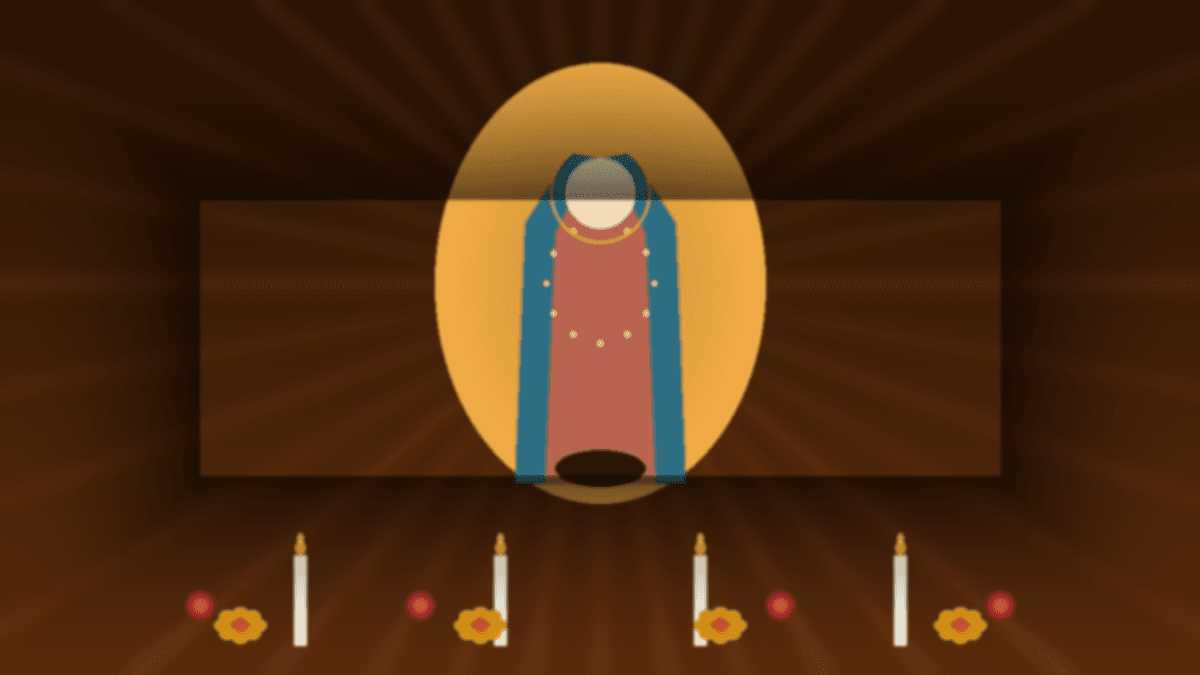
The Prayer to Our Lady of Guadalupe asks for the intercession of the Virgin Mary under her most beloved title in the Western Hemisphere — the image that appeared miraculously on the cloak of a poor indigenous man in 1531 and has never faded in nearly five centuries since.
Key Takeaways
- Our Lady of Guadalupe appeared to Juan Diego four times in December 1531, asking for a church to be built on Tepeyac Hill
- Her image was miraculously imprinted on Juan Diego's tilma (cloak) and remains preserved at the Basilica in Mexico City
- She is patroness of the Americas, Mexico, the Philippines, and the unborn
- Her feast day is December 12, but Catholics pray to her year-round for family, health, and life intentions
- Listen to the Prayer to Our Lady of Guadalupe on Ave Audio for a guided, reverent audio experience
Who Is Our Lady of Guadalupe?
Our Lady of Guadalupe is the Virgin Mary as she appeared in a series of four apparitions to Juan Diego Cuauhtlatoatzin, an indigenous Catholic convert living near Mexico City. The apparitions occurred on December 9, 10, 11, and 12, 1531 — just ten years after the Spanish conquest had upended every social and religious structure the indigenous peoples of Mexico had known.
Mary appeared as a mestiza, a young woman of mixed heritage, dressed in a turquoise star-covered mantle, with rays of light surrounding her and a black cross at her throat — imagery that blended Aztec cosmology with Catholic symbolism in a way that spoke directly to the indigenous people who had just lost their world.
She spoke to Juan Diego in Nahuatl, his own language, and called him xocoyte — a tender Nahuatl word meaning "my youngest and most beloved son." Her message was simple: she wanted a church built on Tepeyac Hill, a place where she had long been honored and where she could be a mother to all who came to her in need.
The Apparition Story
Juan Diego was 57 years old, a widower, and a recent convert to Catholicism. On the morning of December 9, he was walking to Mass when he heard music coming from the summit of Tepeyac Hill and saw a radiant young woman.
She told him to ask the bishop of Mexico City, Juan de Zumárraga, to build a church in her honor on that hill. Juan Diego went to the bishop, who listened politely but asked for a sign. On December 12, the fourth apparition, Our Lady directed Juan Diego to climb the hill and gather the flowers he found there.
It was December — winter. The top of a barren volcanic hill. Yet Juan Diego found Castilian roses in full bloom, flowers that were not native to Mexico and did not grow in that season. Our Lady arranged them herself in his tilma (a rough-woven cloak worn over the shoulders) and told him to take them to the bishop.
When Juan Diego opened his tilma in the bishop's presence, the roses tumbled to the floor — and on the fabric of the cloak, the image of Our Lady of Guadalupe was perfectly imprinted. Bishop Zumárraga fell to his knees. Construction of the first church on Tepeyac began almost immediately.
That tilma has been preserved for nearly 500 years. It now hangs in the Basilica of Our Lady of Guadalupe in Mexico City — the most visited Catholic pilgrimage site in the world, welcoming over 20 million pilgrims each year.
The Prayer to Our Lady of Guadalupe
The traditional prayer to Our Lady of Guadalupe draws directly from her words to Juan Diego: that she is the mother of the true God, that she will hear the laments of those who come to her, and that she will remedy all their miseries, misfortunes, and sorrows.
The prayer typically opens with an act of devotion — acknowledging her as patroness and asking to stand under her protection — and then moves into petition, placing specific needs before her maternal intercession. A common form reads:
Our Lady of Guadalupe, mystical rose, make intercession for holy Church, protect the sovereign pontiff, help all those who invoke thee in their necessities, and since thou art the ever Virgin Mary and Mother of the true God, obtain for us from thy most holy Son the grace of keeping our faith, sweet hope in the midst of the bitterness of life, burning charity, and the precious gift of final perseverance. Amen.
Catholics also frequently add personal petitions — a sick family member, a pregnancy, a difficult decision, an uncertain future. Our Lady of Guadalupe is especially invoked for the protection of the unborn, for families in crisis, and for those facing illness or poverty.
You can listen to the complete Prayer to Our Lady of Guadalupe on Ave Audio, prayed in a reverent, meditative audio format suited to personal prayer or family devotion.
Why Does This Apparition Matter?
The theological significance of Guadalupe runs deeper than a single miraculous event. Within seven years of the apparition, eight million indigenous Mexicans converted to Catholicism — a massive and historically rapid conversion that scholars still study today. Many historians credit the apparition itself as the primary catalyst: Our Lady appeared not as a European queen but as one of the people, speaking their language, wearing their symbols, and calling them beloved.
Pope John Paul II, who visited the Basilica of Our Lady of Guadalupe three times, beatified Juan Diego in 1990 and canonized him in a ceremony in Mexico City on July 31, 2002. In 1999, he proclaimed Our Lady of Guadalupe patroness of all the Americas, placing the entire Western Hemisphere under her maternal protection.
The image on the tilma contains details that have continued to surprise scientists. Studies in the 1970s and 1980s found reflections in the eyes of the image consistent with human corneas — appearing to show the figures present in the bishop's room when Juan Diego opened his cloak. The fabric itself, a coarse ayate weave, has shown no signs of paint, dye, or brush strokes under microscopic analysis. Infrared and ultraviolet examinations have revealed details invisible to the naked eye. No satisfactory natural explanation has been offered for how the image was produced or why it has not degraded.
Her Patronages and Who Prays to Her
Our Lady of Guadalupe holds the following formal patronages:
- The Americas — all of North, Central, and South America (declared by John Paul II, 1999)
- Mexico — the country's most beloved religious figure, inseparable from Mexican Catholic identity
- The Philippines — where devotion to her arrived with Spanish missionaries
- The unborn — she appeared as a pregnant woman, her tilma showing the sash of a woman about to give birth under Aztec custom; the pro-life movement has especially embraced her as patroness
Beyond formal patronages, Catholics pray to her for:
- Protection of families, especially mothers and children
- Healing from illness
- Grace for those facing poverty or displacement
- Reconciliation within families
- Conversion of loved ones who have left the faith
December 12 is her feast day, celebrated with Masses beginning at midnight (the Mañanitas), processions, Aztec dancing, and the scent of copal incense and marigolds outside every church in Mexico. In the United States, parishes with significant Hispanic communities often hold processions, novenas in the nine days leading up to December 12, and special Masses.
How to Incorporate This Prayer into Daily Life
You do not need to wait for December 12 to pray to Our Lady of Guadalupe. Her message to Juan Diego — that she hears the laments of all who come to her — was not seasonal. She offered herself as a permanent refuge.
Daily Marian Prayer
Many Catholics include a brief prayer to Our Lady of Guadalupe in their morning or evening routine. A simple form:
Our Lady of Guadalupe, intercede for me today. Protect my family, guide my decisions, and bring me closer to your Son. Amen.
This can take thirty seconds or thirty minutes depending on your intention. What matters is consistency.
Novena Before December 12
A nine-day novena beginning December 3 and ending on the eve of her feast day is one of the most popular ways to honor her. If you pray the Rosary, adding a decade for her intentions during each novena day is a natural combination.
As Part of a Marian Devotion
Catholics with an active Marian prayer life often rotate devotions: the Rosary, the Divine Mercy Chaplet, the Litany of Loreto, and prayers to Our Lady under her various titles — Fatima, Lourdes, Guadalupe, Czestochowa. Each title reflects a particular aspect of her motherhood and intercession.
If you're looking to deepen your daily prayer life, our guide to Catholic Prayers for Anxiety offers practical prayers for turning to God in moments of worry and uncertainty.
For Specific Intentions
When Catholics face acute need — a health crisis, a pregnancy complication, a family member in danger — they often bring that need directly to Our Lady of Guadalupe by name, placing the intention under her specific patronage. Her message to Juan Diego remains the promise that grounds this prayer: "I will hear your weeping and your sorrow, and I will remedy and alleviate all your multiple sufferings."
The Basilica in Mexico City
For those able to make the journey, the Basilica of Our Lady of Guadalupe in Mexico City is the spiritual home of this devotion. The original tilma is displayed behind bulletproof glass above the main altar in the modern basilica (built in 1976 to accommodate the millions of pilgrims who come each year). Moving walkways carry pilgrims slowly past the tilma so they can view it without stopping traffic.
The basilica complex includes the old 16th-century church, several chapels, Tepeyac Hill itself (accessible by a long staircase or hillside path), and the chapel where Juan Diego is believed to have knelt when he opened his cloak. For Catholics who cannot travel to Mexico City, the prayer on Ave Audio brings this devotion home.
A Prayer for Every Need
What makes Our Lady of Guadalupe's intercession so widely sought is the universality of her promise. She did not appear to a bishop, a scholar, or a military leader. She appeared to an old widower walking to Mass in worn sandals. She told him — and through him, everyone — that she was the mother of every single person who sought her help, regardless of their station.
She appeared in a land that had just been overturned by conquest, to a people who had every reason to despair, and she said: I am here. I hear your cries. I will help you.
That message is as needed now as it was in 1531.
Listen to the Prayer to Our Lady of Guadalupe on Ave Audio and bring your own intentions to her today.
For other Marian and saint devotions, explore our guides to the Novena to St. Joseph, the Prayer to St. Michael the Archangel, and Catholic Prayers for Anxiety.
Listen to the prayers in this guide
Hear Your Prayers Come Alive
Ave Audio turns prayer text into beautiful audio with premium AI voices. Start with 60 free credits — no credit card required.