 Ave Audio
Novena to St. Joseph: Nine Days of Prayer

Lifelong Catholic, Knight of Columbus, and founder of Ave Audio. 20+ years in software engineering.
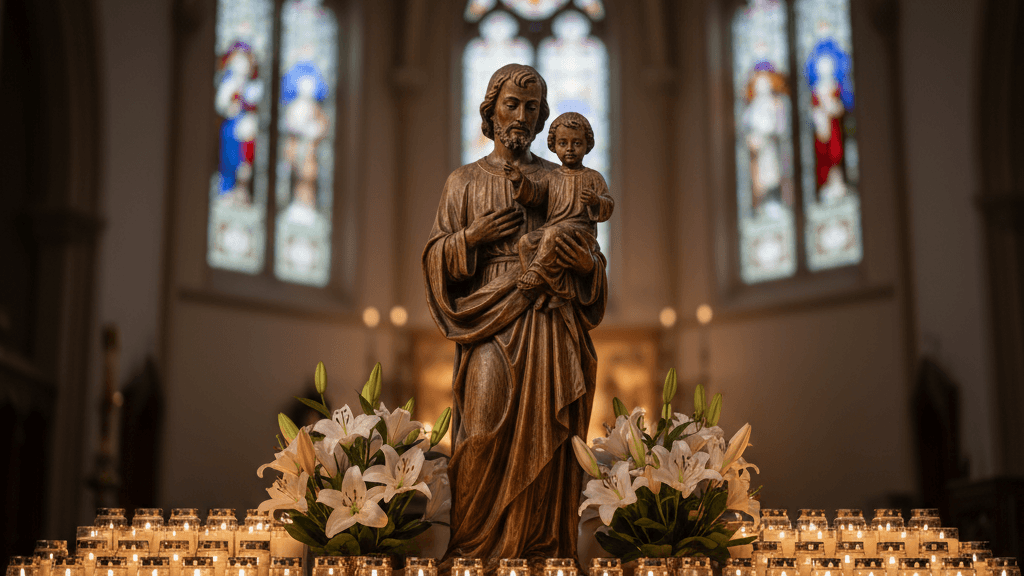
A novena is nine consecutive days of prayer offered for a specific intention, and few novenas carry as much weight in Catholic tradition as the one addressed to St. Joseph. As the foster father of Jesus and spouse of the Blessed Virgin Mary, Joseph holds a unique place among the saints. He is the patron of the universal Church, of workers, of fathers, and of a peaceful death.
Key Takeaways
- A novena is nine days of focused prayer for a specific intention
- St. Joseph is patron of the universal Church, workers, fathers, and the dying
- The devotion dates to the 17th century and has been encouraged by multiple popes
- You can pray it any time of year, though March 10-18 (before his feast day) is most traditional
- Listen to the Novena to St. Joseph on Ave Audio for a guided audio experience
Who Was St. Joseph?
Scripture tells us surprisingly little about Joseph directly. He appears in the infancy narratives of Matthew and Luke, and then largely disappears from the Gospel record. Yet what we do know reveals a man of extraordinary faith and quiet obedience.
Matthew calls Joseph a "righteous man" (Matthew 1:19) -- a description that in Jewish tradition meant someone who faithfully followed God's law while also showing compassion. When he discovered Mary was pregnant, his first instinct was to protect her from public disgrace. When an angel appeared in a dream telling him to take Mary as his wife, he obeyed without recorded hesitation. When warned to flee to Egypt, he rose "during the night" and left immediately (Matthew 2:14).
This pattern of silent, immediate obedience made Joseph a model for Catholics seeking to align their will with God's. He never speaks a single recorded word in Scripture, yet his actions speak volumes about trust, courage, and selfless love.
Pope Pius IX declared Joseph patron of the universal Church in 1870. Pope Francis, who keeps a statue of a sleeping Joseph on his desk, has written extensively about Joseph's role as a quiet, faithful protector. In his 2020 apostolic letter Patris Corde ("With a Father's Heart"), Francis called Joseph "a man who passes unnoticed, a daily, discreet, and hidden presence."
What Is a Novena?
The word novena comes from the Latin novem, meaning nine. The practice traces back to the nine days the apostles and the Blessed Virgin Mary spent in prayer between the Ascension and Pentecost (Acts 1:14). Over centuries, Catholics formalized this pattern into structured nine-day prayers for specific intentions.
A novena is not a magic formula. The Church teaches that its power lies in persistent, faith-filled prayer — the kind Jesus encouraged when he told the parable of the persistent widow (Luke 18:1-8). Praying the same intention for nine days builds spiritual discipline, deepens trust, and opens the heart to whatever answer God provides, even when that answer looks different from what we requested. The USCCB's guide to popular devotions recognizes novenas as a legitimate and enriching form of Catholic popular piety that complements the liturgical life of the Church.
If you're new to novenas, the Novena to St. Joseph is an excellent starting point. Joseph's intercession covers an unusually wide range of needs, including employment, family difficulties, housing, illness, and spiritual growth.
What Is the History Behind the Novena to St. Joseph?
Formal devotion to St. Joseph grew steadily from the Middle Ages onward. St. Teresa of Avila (1515-1582) was one of his most vocal advocates, writing in her autobiography: "I do not remember even now that I have ever asked anything of him which he has failed to grant."
The specific novena prayers developed during the 17th and 18th centuries as part of a broader movement to honor Joseph more prominently in Catholic worship. Key milestones include:
- 1621 — Pope Gregory XV made March 19 a holy day of obligation
- 1870 — Pope Pius IX declared Joseph patron of the universal Church
- 1889 -- Pope Leo XIII issued Quamquam Pluries, calling on Catholics to seek Joseph's intercession
- 1955 — Pope Pius XII established May 1 as the Feast of St. Joseph the Worker
- 2020 — Pope Francis declared a Year of St. Joseph and issued Patris Corde
The novena tradition gained particular popularity among Catholic immigrants in the 19th and early 20th centuries, who turned to Joseph, a working man who protected his family through displacement and uncertainty, as someone who understood their struggles firsthand.
How to Pray the Novena
Praying a novena requires no special equipment or location. You need only a quiet moment, your intention, and the prayers themselves. Here is a simple framework:
Before You Begin
- Choose your intention. Be specific. "Help me find meaningful work" is better than a vague request. You can hold multiple intentions, but clarity helps focus your prayer.
- Pick your nine days. Any nine consecutive days work. The most traditional period is March 10-18, ending the day before St. Joseph's feast on March 19.
- Find a consistent time. Morning, evening, or a lunch break — consistency matters more than the specific hour.
Daily Prayer Structure
Each day of the novena follows this pattern:
- Opening prayer — Address St. Joseph and state your intention
- Day-specific meditation — Reflect on a particular virtue or aspect of Joseph's life
- Core novena prayer — The traditional prayer repeated each day
- Closing prayer — An Our Father, Hail Mary, and Glory Be
The full prayer texts vary by tradition. The version below follows the most widely used form, anchored by the traditional To you, O blessed Joseph prayer promulgated by Pope Leo XIII in 1889. Each day focuses on a different aspect of Joseph's life: his role as husband, father, worker, protector, and model of faith.
The Traditional Prayer (Prayed Every Day)
To you, O blessed Joseph, do we come in our tribulation, and having implored the help of your most holy Spouse, we confidently invoke your patronage also. Through that charity which bound you to the Immaculate Virgin Mother of God and through the paternal love with which you embraced the Child Jesus, we humbly beg you graciously to regard the inheritance which Jesus Christ has purchased by His Blood, and with your power and strength to aid us in our necessities.
O most watchful Guardian of the Holy Family, defend the chosen children of Jesus Christ; O most loving father, ward off from us every contagion of error and corrupting influence; O our most mighty protector, be kind to us and from heaven assist us in our struggle with the power of darkness.
As once you rescued the Child Jesus from deadly peril, so now protect God's Holy Church from the snares of the enemy and from all adversity; shield, too, each one of us by your constant protection, so that, supported by your example and your aid, we may be able to live piously, to die in holiness, and to obtain eternal happiness in heaven. Amen.
Day 1 — St. Joseph, Faithful Guardian
Glorious St. Joseph, faithful servant of Jesus Christ, to you we raise our hearts and our hands to implore your powerful intercession in obtaining from the kind Heart of Jesus all the helps and graces necessary for our spiritual and temporal welfare, particularly the grace of a happy death, and the special favor we now implore: [state your intention].
Pray the traditional prayer above, then: Our Father, Hail Mary, Glory Be.
Day 2 — St. Joseph, Silent Witness
St. Joseph, you who heard God's will in dreams and obeyed without a single recorded word, teach us to listen. Help us trust God even when His direction does not match our own plans. Pray for us now, especially for the intention we carry in our hearts: [state your intention].
Pray the traditional prayer above, then: Our Father, Hail Mary, Glory Be.
Day 3 — St. Joseph, Husband of Mary
Chaste spouse of the Blessed Virgin Mary, you protected and provided for the Mother of God with tenderness and honor. Obtain for all married couples the grace of faithful love, and for those preparing for marriage, the wisdom to choose well. Hear our prayer for: [state your intention].
Pray the traditional prayer above, then: Our Father, Hail Mary, Glory Be.
Day 4 — St. Joseph, Foster Father of Jesus
St. Joseph, foster father of the Son of God, you raised Jesus in the carpenter's shop and taught Him the work of human hands. Intercede for all fathers — especially those carrying heavy burdens — that they may love their children with your quiet, steady strength. We ask your help for: [state your intention].
Pray the traditional prayer above, then: Our Father, Hail Mary, Glory Be.
Day 5 — St. Joseph, Protector of the Holy Family
Protector of the Holy Family, you fled to Egypt to save the Child Jesus and led them home in safety. Protect our families, our parishes, and the universal Church from every danger of body and soul. Present to Jesus our urgent need: [state your intention].
Pray the traditional prayer above, then: Our Father, Hail Mary, Glory Be.
Day 6 — St. Joseph, Model of Workers
Patron of workers, you labored with your hands to provide for the Holy Family. Bless all who work, especially those struggling to find employment or to provide for their families. Intercede for: [state your intention].
Pray the traditional prayer above, then: Our Father, Hail Mary, Glory Be.
Day 7 — St. Joseph, Patron of a Happy Death
St. Joseph, who died in the arms of Jesus and Mary, you are the patron of a happy death. Pray for all who are approaching their last hour, for those who have died, and for us when our time comes. Grant us this grace especially for: [state your intention].
Pray the traditional prayer above, then: Our Father, Hail Mary, Glory Be.
Day 8 — St. Joseph, Hope of the Sick
Compassionate St. Joseph, you understand human frailty and suffering. Bring comfort to the sick, courage to caregivers, and healing where it is God's will. Please hear our prayer for: [state your intention].
Pray the traditional prayer above, then: Our Father, Hail Mary, Glory Be.
Day 9 — St. Joseph, Patron of the Universal Church
Patron of the universal Church, defend the body of Christ from every assault and strengthen every Catholic in the apostolic faith. On this final day, we place our needs before you with confidence: [state your intention].
Pray the traditional prayer above, then: Our Father, Hail Mary, Glory Be. End with: "St. Joseph, pray for us."
For a guided audio version of these prayers, listen to the full novena on Ave Audio.
Tips for Staying Consistent
Nine days can feel long, especially if life gets busy. A few strategies that help:
- Set a daily reminder on your phone for your chosen prayer time
- Listen to the audio version on Ave Audio during your commute or before bed — hearing the prayers spoken can help maintain focus when you're tired
- Pray with someone else — a spouse, friend, or prayer group adds accountability
- Journal briefly after each day's prayer — even one sentence about what struck you
When to Pray This Novena
While any time works, certain periods carry special significance:
- March 10-18 — The nine days before the Solemnity of St. Joseph (March 19)
- April 22-30 — Leading up to the Feast of St. Joseph the Worker (May 1)
- Before major life decisions — Job changes, moves, marriage, or family transitions
- During times of financial difficulty — Joseph is patron of workers and providers
- When facing family struggles — As head of the Holy Family, Joseph intercedes for domestic harmony
Many Catholics also turn to this novena when praying for a happy death, as tradition holds that Joseph died in the arms of Jesus and Mary — the most peaceful departure imaginable.
What Are the Areas of St. Joseph's Patronage?
Joseph's intercession covers remarkably broad territory. He is formally recognized as patron of:
- The universal Church — declared by Pope Pius IX in 1870
- Workers and craftsmen — a carpenter who supported his family through skilled labor
- Fathers — the model of quiet, sacrificial fatherhood
- The dying — tradition holds he died peacefully with Jesus and Mary present
- Immigrants and displaced people — he fled with his family to Egypt as refugees
- Home sellers and buyers — a popular devotion, though more folk practice than formal theology
This breadth explains why the novena to St. Joseph is among the most frequently prayed novenas worldwide. Whatever your situation, Joseph likely experienced something analogous: uncertainty about the future, responsibility for others, financial pressure, displacement, or the challenge of trusting God when the path ahead was unclear.
Connecting Novena Prayer to Daily Life
The purpose of a novena is not just to ask for something. Praying the same intention for nine consecutive days changes the person praying. It slows the impulse to demand immediate answers. It builds the habit of turning to God before turning to anxiety. It teaches patience.
St. Joseph models this beautifully. He received divine instructions through dreams. Brief, cryptic messages that required him to uproot his life. He never argued, never asked for clarification, never hesitated. His novena invites us into that same posture of radical trust.
If you're drawn to deepen your prayer life beyond the novena, explore other Catholic devotions like the Rosary, the Divine Mercy Chaplet, or the Prayer to St. Michael. Each offers a different window into the richness of Catholic tradition.
For daily prayer habits, our guide on Catholic Prayers Before Meals shows how even brief moments of prayer can transform ordinary routines into encounters with grace.
Listen to the Novena
Hearing prayers spoken aloud can transform the experience — especially during a nine-day commitment when mental fatigue sets in. The Novena to St. Joseph on Ave Audio offers the complete prayer in a reverent, paced audio format designed for daily listening.
Whether you're praying for a job, a family member, or simply a deeper relationship with God, St. Joseph stands ready to intercede. Begin your nine days today.
Hear Your Prayers Come Alive
Ave Audio turns prayer text into beautiful audio with premium AI voices. Start with 60 free credits — no credit card required.