 Ave Audio
How to Pray the Angelus (and the Regina Caeli)

Lifelong Catholic, Knight of Columbus, and founder of Ave Audio. 20+ years in software engineering.
Key Takeaways
- The Angelus is prayed three times daily (6 AM, noon, 6 PM) in memory of the Annunciation
- It consists of three Hail Marys plus versicles and a collect — about two minutes total
- During Easter season (Easter Sunday through Pentecost), it is replaced by the Regina Caeli
- "The Word was made flesh" is accompanied by a genuflection or deep bow
- Listen to the Hail Mary on Ave Audio — the central prayer of the Angelus
For over eight centuries, Catholic life has been marked by the sound of church bells at 6 AM, noon, and 6 PM. These bells are not decorative. They are an invitation — a call to pause whatever you are doing and spend two minutes before God, remembering the moment that changed human history: the moment the Son of God became flesh in the womb of the Virgin Mary.
That prayer is the Angelus.
It is one of the most compact, beautiful, and theologically rich devotions in the Catholic tradition. Popes pray it publicly every Sunday from the window of the papal apartments. Monks pray it in monasteries. Farmers once paused in their fields for it. You can pray it from your car on your lunch break.
This guide explains the complete Angelus, the Regina Caeli that replaces it in Easter season, how to pray them, and why they still matter for modern Catholic life.
What Is the Angelus?
The Angelus is named for its opening word in Latin: Angelus Domini nuntiavit Mariae — "The Angel of the Lord declared unto Mary." It is a prayer of the Annunciation, the moment described in Luke 1:26-38 when the Archangel Gabriel appeared to the Virgin Mary and announced that she would conceive and bear the Son of God. Mary's response — "Be it done unto me according to thy word" — is the fiat that opened the door of salvation.
The prayer developed over several centuries. By the 13th century, Franciscan friars were ringing bells in the evening to prompt Catholics to say three Hail Marys in honor of the Incarnation. Over the following two centuries, morning and midday prayers were added, and by the 16th century, the Angelus had reached roughly its current form.
Pope Benedict XIII formally approved the complete three-times-daily Angelus in 1724. Pope John Paul II reinvigorated the tradition in 1978 by praying it publicly from his window each Sunday, a custom continued by his successors to this day. You can read more about the history and practice of the Angelus on the Vatican website.
What Are the Words of the Angelus?
The Angelus is structured as three versicle-and-response pairs, each followed by a Hail Mary, and concluded with a collect prayer. The leader (or the first voice) says the versicle; the response follows.
V. The Angel of the Lord declared unto Mary. R. And she conceived of the Holy Spirit.
Hail Mary, full of grace, the Lord is with thee. Blessed art thou among women, and blessed is the fruit of thy womb, Jesus. Holy Mary, Mother of God, pray for us sinners, now and at the hour of our death. Amen.
V. Behold the handmaid of the Lord. R. Be it done unto me according to thy word.
Hail Mary...
V. And the Word was made flesh. R. And dwelt among us.
Hail Mary...
V. Pray for us, O Holy Mother of God. R. That we may be made worthy of the promises of Christ.
Let us pray. Pour forth, we beseech Thee, O Lord, Thy grace into our hearts; that we, to whom the Incarnation of Christ, Thy Son, was made known by the message of an Angel, may by His Passion and Cross be brought to the glory of His Resurrection; through the same Christ our Lord. Amen.
The Genuflection at "The Word Was Made Flesh"
When you reach the third versicle — "And the Word was made flesh" — the traditional practice is to genuflect (touch one knee to the ground) or bow deeply. This physical gesture honors the Incarnation itself: the most sublime mystery in human history, God becoming man. It is one of the few moments outside of Mass when Catholics make a full genuflection in prayer, and it carries significant weight.
If you are praying while driving, a slight bow of the head or a moment of interior recollection fulfills the spirit of this gesture.
How Do You Pray the Angelus?
Step 1: At 6 AM, noon, or 6 PM (or whenever you pray it), set down what you are doing. Even ten seconds of stillness helps.
Step 2: Begin with the first versicle: "The Angel of the Lord declared unto Mary." If praying alone, you say both the versicle and response yourself.
Step 3: Pray the Hail Mary slowly and attentively. The Hail Mary is the heart of the Angelus — it is said three times, once after each versicle. Do not rush it.
Step 4: At the third versicle — "The Word was made flesh" — genuflect or bow. Let the words land. This is the Incarnation you are remembering.
Step 5: Conclude with "Pray for us, O Holy Mother of God / That we may be made worthy of the promises of Christ." Then pray the collect prayer.
The entire prayer takes under two minutes. Its power is not in length but in consistency. Catholics who have prayed the Angelus daily for years describe it as an anchor — a moment that re-orients the whole day toward God.
Why Do Catholics Pray at Noon?
The Church's ancient tradition of praying at specific hours — what became the Liturgy of the Hours — assigned midday (Sext) as a time of special vigilance. Noon was the time of Christ's crucifixion according to some Gospel accounts. It is also the natural midpoint of the working day, the moment when busyness peaks and the spiritual life is most easily crowded out.
The Angelus at noon is a small act of rebellion against that crowding. It says: the middle of the day belongs to God. Not to a deadline, not to a meeting, not to email. Two minutes for the Incarnation.
St. Francis de Sales, the 17th-century bishop and spiritual director, wrote extensively about sanctifying the ordinary moments of life. He would have recognized the Angelus immediately as exactly this: ordinary time made sacred by brief, deliberate prayer.
Many Catholics today set a phone alarm for noon labeled simply "Angelus" or "The Bell." When it sounds, they stop — even for a few seconds — and pray. This contemporary bell is no less valid than the one in the campanile.
What Is the Regina Caeli and When Is It Prayed?
From Easter Sunday through Pentecost Sunday, the Church does not pray the Angelus. Instead, the ancient Marian antiphon called the Regina Caeli — "Queen of Heaven" — takes its place.
The reason is theological. The Angelus commemorates the Annunciation and the Incarnation. During Easter season, the Church lives in the light of the Resurrection. A prayer of Annunciation would be incomplete without the culmination it was preparing for. The Regina Caeli celebrates that culmination.
The Regina Caeli dates to at least the 12th century. Pope Gregory V is sometimes credited with mandating it. For centuries it was sung by the Pope in procession on Holy Saturday. Today it is the Sunday noon prayer proclaimed by the Pope from the Vatican and is prayed by Catholics worldwide at the same times as the Angelus.
The Full Text of the Regina Caeli
V. O Queen of Heaven, rejoice, alleluia. R. For He whom thou didst merit to bear, alleluia.
V. Hath risen as He said, alleluia. R. Pray for us to God, alleluia.
V. Rejoice and be glad, O Virgin Mary, alleluia. R. For the Lord hath truly risen, alleluia.
Let us pray. O God, who gave joy to the world through the Resurrection of Thy Son, our Lord Jesus Christ: grant, we beseech Thee, that through the intercession of the Virgin Mary, His Mother, we may obtain the joys of everlasting life. Through the same Christ our Lord. Amen.
The alleluia that punctuates every line is the sound of Easter: the word the Church falls silent on during Lent and then sings with relief and exultation from Easter Sunday onward. To pray the Regina Caeli is to inhabit the joy of the Resurrection rather than simply hear about it.
Why Is the Hail Mary the Center of the Angelus?
The Hail Mary is the structural and spiritual center of the Angelus. It is prayed three times — once after each of the three mysteries recalled in the versicles. Understanding what the Hail Mary is helps you understand why the Angelus is built on it.
The Hail Mary comes directly from Scripture. The first half — "Hail Mary, full of grace, the Lord is with thee. Blessed art thou among women, and blessed is the fruit of thy womb, Jesus" — combines Gabriel's greeting (Luke 1:28) with Elizabeth's greeting (Luke 1:42). It is the greeting of heaven and the greeting of earth joined together.
The second half — "Holy Mary, Mother of God, pray for us sinners, now and at the hour of our death" — is the Church's petition, formalized in the 16th century. It asks Mary's intercession at the two most decisive moments of human existence: now (this present moment) and the hour of death.
When you pray the Hail Mary within the Angelus, you are not merely reciting a memorized prayer. You are aligning your present moment with the first moment of the Incarnation, asking the Mother of God to keep you close to her Son from now until the very end.
Listen to the Hail Mary on Ave Audio — a beautifully recorded version you can pray aloud with or use to learn the rhythm of the prayer. Hearing it prayed at a contemplative pace, rather than at the speed of habit, can restore attention and meaning to familiar words.
How Can You Build the Angelus into Daily Life?
The greatest obstacle to praying the Angelus is not complexity — the prayer is two minutes long — but forgetting. Here are practical approaches Catholics have found helpful:
Set a recurring alarm. Three daily alarms (6 AM, noon, 6 PM) labeled "Angelus" or "Bell." Many Catholics only use the noon alarm and build from there.
Pray before lunch. If three daily bells feel like too much to start, make the noon Angelus part of your lunch habit. Say it before you eat, as naturally as grace before meals.
Keep the text visible. A printed card in your wallet, a bookmark in your journal, or the text saved as a note on your phone means you always have the words available when the bell rings.
Use audio prayer. If you find your mind wandering while praying from memory, listening to a recording can help anchor your attention. Ave Audio's catalog includes the Hail Mary and other foundational Catholic prayers in reverent, paced audio recordings — browse the full catalog of audio prayers for daily prayer companions.
Pray with family. The Angelus is naturally communal — it is structured as a call-and-response. Families who pray it together at noon or evening find it becomes a ritual the children remember for life.
What Is the History of the Angelus Bell?
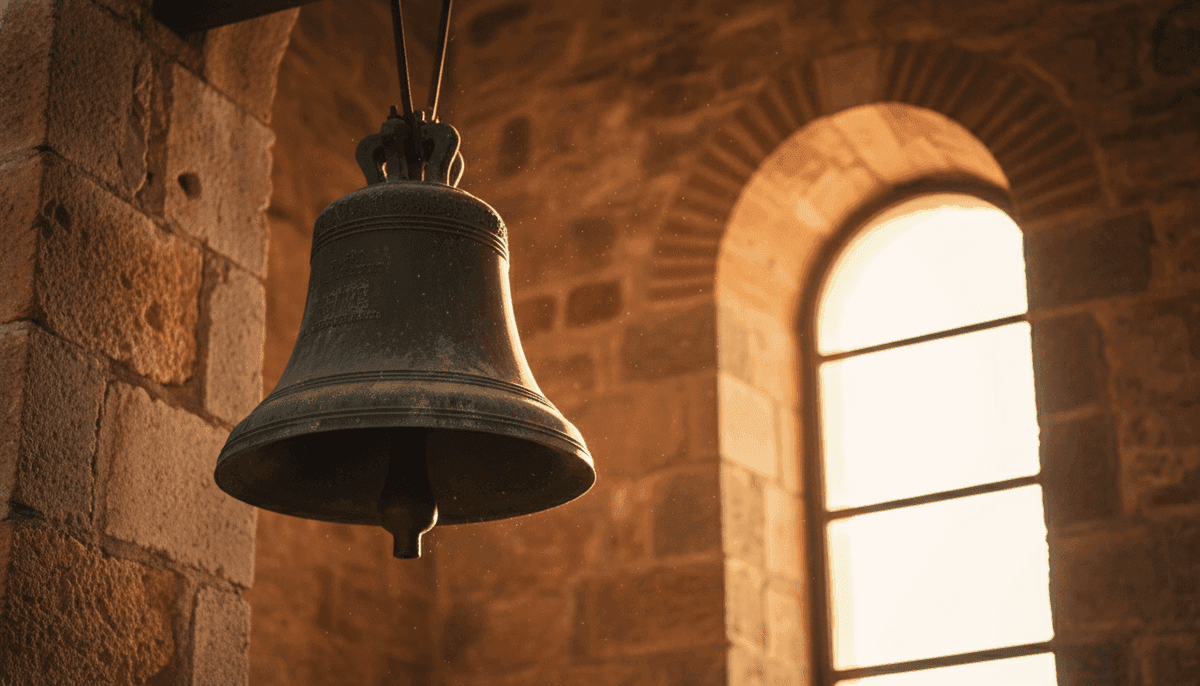
The connection between the Angelus and bells is ancient and deeply embedded in Catholic culture. In medieval Europe, church bells regulated community life — marking hours, calling to Mass, announcing deaths, signaling danger. The Angelus bell was the bell of peace, the bell of prayer.
The great 19th-century French painter Jean-François Millet memorialized this tradition in his famous painting The Angelus (1857-1859), now in the Musée d'Orsay in Paris. It depicts two peasants in a field pausing from their work, heads bowed, at the sound of the distant church bell. The woman holds her hat; the man stands cap in hand; the hayfork rests on the ground. It is one of the most reproduced religious paintings of the modern era, and it captures exactly what the Angelus is: an interruption of ordinary life by the sacred.
That painting hung on the wall of Pope John Paul II's private chapel. He prayed the Angelus publicly each Sunday for the entirety of his 26-year pontificate, using the moment after the prayer to offer brief reflections on the Gospel and the condition of the world. This practice gave the Angelus a new global visibility and renewed its connection to the papacy, Catholic social teaching, and the lived experience of Catholics worldwide.
Listen on Ave Audio
Ave Audio offers the Hail Mary — the foundational prayer of the Angelus — in a beautifully produced audio recording designed for prayer, not just listening. Whether you are learning the Hail Mary for the first time, re-engaging with a prayer that has become automatic, or praying along as part of your Angelus practice, audio can restore attentiveness to familiar words.
Listen to the Hail Mary on Ave Audio: Browse the catalog and pray along at your own pace. New users receive 60 free credits — enough to explore dozens of Catholic audio prayers at no cost.
You can also explore the full Ave Audio prayer catalog for the Morning Prayer, Divine Mercy Chaplet, Rosary mysteries, and other daily Catholic prayers that pair naturally with the Angelus as part of a complete prayer routine.
Conclusion: Two Minutes, Three Times a Day
The Angelus is not demanding. It asks two minutes, three times a day — six minutes of total daily prayer — to remember the moment God became man. In a world of constant noise and distraction, this rhythm is itself a spiritual discipline: a small, repeated act of attention to what is most important.
Start with just the noon Angelus. Set an alarm. When it sounds, put down what you are doing. Pray the three Hail Marys. Bow at the Incarnation. Pray the collect. Then go back to your life.
Do this for a week, and you will understand why Catholics have done it for eight centuries.
For more Catholic prayer guides, see How to Pray the Rosary, How to Pray the Divine Mercy Chaplet, and How to Start a Daily Prayer Routine.
Listen to the prayers in this guide
Hear Your Prayers Come Alive
Ave Audio turns prayer text into beautiful audio with premium AI voices. Start with 60 free credits — no credit card required.