 Ave Audio
How to Pray the Stations of the Cross

Lifelong Catholic, Knight of Columbus, and founder of Ave Audio. 20+ years in software engineering.
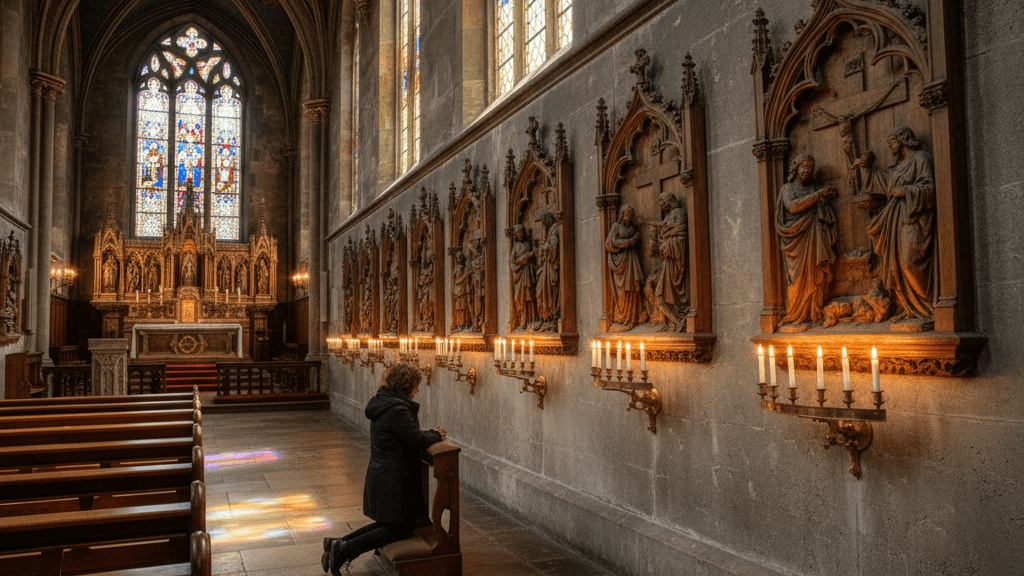
The Stations of the Cross is a walking meditation through the final hours of Jesus Christ's life, from his condemnation by Pontius Pilate to his burial in the tomb. Each of the 14 stations marks a moment along the Via Dolorosa — the road of suffering — and invites the person praying to pause, reflect, and enter into that moment of Christ's Passion.
Key Takeaways
- The Stations of the Cross traces 14 moments of Jesus' journey to Calvary
- Each station includes a meditation, a prayer, and a physical movement (standing, kneeling, walking)
- The devotion takes 30-45 minutes and is most common during Lent, especially Good Friday
- You can pray the Stations in church, at home, or while listening to the Stations of the Cross audio playlist on Ave Audio
- The practice dates to early Christian pilgrims walking the actual route in Jerusalem
What Are the Stations of the Cross?
The Stations of the Cross (also called the Way of the Cross or Via Crucis) are 14 scenes depicting Jesus' journey from Pilate's judgment hall to the tomb where he was buried. In most Catholic churches, you will find 14 images or relief sculptures mounted along the walls, typically starting near the sanctuary and progressing around the nave.
The devotion emerged from the practice of early Christians who physically walked the route in Jerusalem where Jesus carried his cross. By the late Middle Ages, Franciscan friars had formalized the practice for those who could not make the pilgrimage, installing representations of the stations in churches throughout Europe.
Pope Clement XII fixed the number at 14 in 1731. The traditional stations include both Gospel-attested events and scenes from sacred tradition. In 1991, Pope John Paul II introduced a scriptural variation that uses only events found in the Gospels.
The 14 Traditional Stations
Here are all 14 stations with their meditations:
Station 1: Jesus Is Condemned to Death
Pilate washes his hands and delivers Jesus to be crucified (Matthew 27:24-26). This station invites reflection on unjust judgment and the courage to accept suffering we do not deserve.
Station 2: Jesus Carries His Cross
Jesus takes up the wooden cross and begins the walk to Golgotha (John 19:17). We meditate on the weight of our own crosses and Christ's willingness to bear them.
Station 3: Jesus Falls the First Time
Weakened from scourging, Jesus stumbles under the cross. This station, from tradition rather than Scripture, reminds us that falling is not the same as failing. Christ gets up and continues.
Station 4: Jesus Meets His Mother
Mary encounters her son on the road to Calvary. Simeon's prophecy is fulfilled: "A sword will pierce your own soul too" (Luke 2:35). This station honors the suffering of those who love the afflicted.
Station 5: Simon of Cyrene Helps Jesus
The soldiers compel a bystander named Simon to carry the cross (Mark 15:21). Simon did not volunteer. Sometimes we are called to serve in ways we did not choose.
Station 6: Veronica Wipes the Face of Jesus
According to tradition, a woman named Veronica stepped forward to wipe the blood and sweat from Jesus' face, and his image was imprinted on her cloth. This station celebrates small acts of compassion amid overwhelming suffering.
Station 7: Jesus Falls the Second Time
Jesus falls again. The repetition matters. Sanctity is not about never falling but about always rising. This station speaks to anyone trapped in cycles of struggle.
Station 8: Jesus Meets the Women of Jerusalem
Jesus tells the weeping women, "Do not weep for me; weep for yourselves and for your children" (Luke 23:28). Even in agony, Christ ministers to others.
Station 9: Jesus Falls the Third Time
A final collapse before the hill of Calvary. Three falls echo Peter's three denials. Both end in restoration. This station is for anyone who has failed repeatedly and fears they cannot go on.
Station 10: Jesus Is Stripped of His Garments
The soldiers divide his clothing by lot (John 19:23-24). Jesus is left with nothing. This station meditates on detachment from worldly possessions and the vulnerability of total surrender.
Station 11: Jesus Is Nailed to the Cross
The crucifixion itself (Luke 23:33). The physical agony is beyond description. This station calls us to sit with suffering rather than rush past it.
Station 12: Jesus Dies on the Cross
"Father, into your hands I commend my spirit" (Luke 23:46). The moment of death. Many parishes observe a period of silence at this station.
Station 13: Jesus Is Taken Down from the Cross
Joseph of Arimathea and Nicodemus remove the body (John 19:38-40). Mary receives her son's body. This station, often depicted as the Pieta, meditates on grief and letting go.
Station 14: Jesus Is Laid in the Tomb
The body is placed in a new tomb cut from rock (Matthew 27:59-60). The stone is rolled across the entrance. The story appears to end. But Catholics know what happens on the third day.
How to Pray the Stations
In Church
- Begin at the first station (usually near the front of the church on the right side)
- At each station, stand before the image
- Announce the station: "We adore you, O Christ, and we praise you. Because by your holy cross, you have redeemed the world."
- Read or listen to the meditation for that station
- Pray an Our Father, Hail Mary, and Glory Be
- Walk to the next station
- After the 14th station, many conclude with a closing prayer
At Home
You do not need a church to pray the Stations. Many families:
- Print or display small images of each station along a wall or hallway
- Use a Stations of the Cross booklet or prayer book
- Listen to the Stations of the Cross audio playlist on Ave Audio, which guides you through each station with prayer and meditation
- Walk outdoors, pausing at 14 points along a path
The Prayer at Each Station
The traditional prayer said before each station:
We adore you, O Christ, and we praise you. Because by your holy cross, you have redeemed the world.
After the meditation, pray:
- One Our Father
- One Hail Mary
- One Glory Be
Some versions add: "Lord Jesus, help me to walk with you."
When Should Catholics Pray the Stations of the Cross?
The Stations of the Cross are most associated with Lent, the 40-day season of preparation before Easter. Specifically:
- Every Friday during Lent — Many parishes hold communal Stations services, often at 7 PM
- Good Friday — The most solemn day for this devotion. Some communities walk the Stations outdoors through town
- Any Friday year-round — Friday is the traditional day for meditating on Christ's Passion
- Any time of personal suffering — The Stations offer a framework for uniting your pain with Christ's
If you are preparing for Lent, our guide to Catholic Prayers for Lent covers additional daily prayers and devotions for the season.
What Is the Spiritual Purpose of the Stations of the Cross?
The Stations of the Cross are not mere historical reenactment. The Church teaches that by walking with Christ through his suffering, we:
- Develop compassion — Entering into another's pain, even imaginatively, builds empathy
- Unite our suffering with Christ's — Catholic theology holds that human suffering, when offered to God, participates in the redemptive work of the cross
- Practice repentance — The Stations confront us with the cost of sin and the depth of God's mercy
- Prepare for the Resurrection — The story does not end at the tomb. Walking through death with Christ deepens our understanding of Easter
St. Alphonsus Liguori, Doctor of the Church and founder of the Redemptorists, whose version of the Stations remains the most widely used, wrote: "My Jesus, I love you more than myself. I am sorry that I have offended you. Never let me offend you again."
Listen to the Stations
Walking through all 14 Stations with focused prayer and meditation takes concentration. An audio guide can help maintain the rhythm and depth of the devotion, especially when praying alone.
The Stations of the Cross playlist on Ave Audio walks you through each station with the opening prayer, meditation, and response prayers. You can listen while walking the Stations in church, following along at home, or during a contemplative walk outdoors.
For other prayer guides, explore our posts on the Rosary, the Divine Mercy Chaplet, and the Novena to St. Joseph.
Listen to the prayers in this guide
Hear Your Prayers Come Alive
Ave Audio turns prayer text into beautiful audio with premium AI voices. Start with 60 free credits — no credit card required.