 Ave Audio
How to Pray the Hail Holy Queen (Salve Regina)

Lifelong Catholic, Knight of Columbus, and founder of Ave Audio. 20+ years in software engineering.
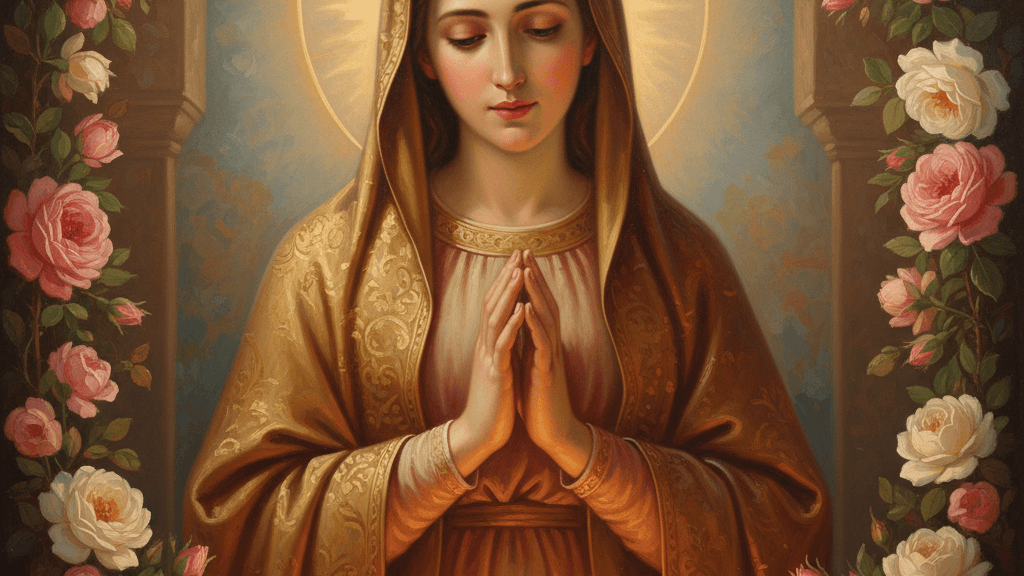
The Hail Holy Queen (Salve Regina in Latin) is one of the most beloved Marian prayers in the Catholic Church. Prayed at the end of every Rosary, sung at solemn liturgies, and recited daily in the Liturgy of the Hours, it has been on Catholic lips for nearly a thousand years. It is a prayer of exile — honest about the hardships of this life — and of hope, asking Mary to turn her merciful eyes toward us and lead us to her Son.
Key Takeaways
- The Hail Holy Queen is traditionally prayed at the end of each Rosary
- It was composed in Latin (Salve Regina) around the 11th century, likely by Herman of Reichenau
- The prayer addresses Mary as "our life, our sweetness, and our hope" — titles that reflect her role as advocate and mother
- It is also prayed daily in the Liturgy of the Hours from Trinity Sunday through Advent
- Listen to the Hail Holy Queen on Ave Audio with a professionally produced AI voice
Full Text of the Hail Holy Queen
The traditional English translation used in most Catholic parishes:
Hail, holy Queen, Mother of Mercy, our life, our sweetness, and our hope. To thee do we cry, poor banished children of Eve; to thee do we send up our sighs, mourning and weeping in this valley of tears. Turn then, most gracious advocate, thine eyes of mercy toward us; and after this our exile, show unto us the blessed fruit of thy womb, Jesus. O clement, O loving, O sweet Virgin Mary.
V. Pray for us, O holy Mother of God. R. That we may be made worthy of the promises of Christ.
The versicle (V.) and response (R.) are used when the prayer is prayed communally; when praying alone, simply pray both lines.
What Is the Hail Holy Queen?
The Hail Holy Queen is a Marian antiphon — a short chant or prayer honoring Mary that is prayed at fixed moments in Catholic worship. The Church has four traditional Marian antiphons assigned to different seasons of the liturgical year. The Salve Regina is prayed from Trinity Sunday (late spring) through the Saturday before Advent, making it the longest-running antiphon in the liturgical calendar.
Within the Rosary, it closes the entire prayer after the final decade. This placement is deliberate: the Rosary meditates on the life of Christ through the lens of Mary's witness, and the Hail Holy Queen is a fitting close — a collective cry to our heavenly mother to bring us home to the One whose life we have just contemplated.
The prayer is structured as a lament-turned-petition. It begins by acclaiming Mary in rich titles: Queen, Mother of Mercy, our life, our sweetness, our hope. It then names the reality of earthly life: we are banished children of Eve, weeping in a valley of tears. Finally, it makes its request: turn your eyes toward us, show us Jesus, and lead us out of this exile.
That movement — from praise, to honest naming of suffering, to confident petition — mirrors the structure of the Psalms and reflects deep Catholic theological wisdom.
How to Pray the Hail Holy Queen
As Part of the Rosary
The most common context for the Hail Holy Queen is at the end of the Rosary. After you complete the five decades and the Hail Mary, Our Father, and Glory Be for the final decade, you pray:
- The Hail Holy Queen (full text above)
- The Closing Prayer: O God, whose Only Begotten Son, by his life, death, and resurrection, has purchased for us the rewards of eternal life, grant, we beseech thee, that while meditating on these mysteries of the most holy Rosary of the Blessed Virgin Mary, we may imitate what they contain and obtain what they promise, through the same Christ our Lord. Amen.
- The Sign of the Cross
If you pray the Rosary daily or want to learn it well, you can listen to the Hail Holy Queen on Ave Audio to internalize the rhythm and phrasing before attempting it from memory.
In the Liturgy of the Hours
For Catholics who pray the Liturgy of the Hours (the Divine Office), the Hail Holy Queen is the prescribed Marian antiphon at the end of Compline (Night Prayer) from Trinity Sunday through the Saturday before Advent. After the responsory and collect, the leader intones the Salve Regina and the community prays it together.
If you are just beginning to pray the Liturgy of the Hours, Compline is the easiest office to start with. It is brief, typically five to ten minutes, and ending the day with the Salve Regina is a beautiful act of entrustment to Mary before sleep.
During May and October
May is the Month of Mary and October is the Month of the Rosary. Many parishes and families add the Hail Holy Queen to their daily prayers throughout both months — either as part of a full Rosary or as a standalone Marian prayer. Praying it every day for thirty-one days is one of the fastest ways to memorize it permanently.
As a Personal Devotion
There is no rule that says the Hail Holy Queen must be prayed in a particular context. Many Catholics pray it:
- As a morning offering to Mary
- Before making a major decision
- At bedside in the evening
- During times of grief, illness, or anxiety
The prayer's honesty about suffering — "mourning and weeping in this valley of tears" — makes it particularly fitting during hard seasons of life. It names the pain without minimizing it and lifts it immediately to a Mother who can intercede.
History and Origins
The Salve Regina was composed in Latin around the 11th century. Its authorship remains debated — the most common attribution is to Herman of Reichenau (1013–1054), a Benedictine monk born with severe physical disabilities who became one of the great scholars of his age. That the prayer's most vivid image — "mourning and weeping in this valley of tears" — came from a man who lived with constant suffering adds a layer of authenticity that centuries of devotion have only deepened.
Other scholars attribute the prayer to Adhémar of Monteil, Bishop of Le Puy, who is said to have led the First Crusade with the Salve Regina on his lips. Still others point to Peter of Compostela, a Spanish composer of Marian hymns.
What is undisputed is that the Dominicans shaped how most Catholics know the prayer today. When St. Dominic and his friars began propagating the Rosary in the 13th century, they added the Salve Regina as its closing prayer. From the Dominican convents and preaching houses, the practice spread across the Catholic world.
By the 15th century, sailors crossing the Atlantic sang the Salve Regina as a daily devotion. Columbus reportedly led his crew in the prayer each evening at sea. The tradition of singing it at sunset has continued in some Catholic communities as a beautiful way to commend the day's journey to Mary.
Pope Leo XIII, who wrote twelve encyclicals on the Rosary and was deeply devoted to Mary, described the Salve Regina as the prayer that best captures the Church's longing for heaven. He formally assigned it to the Rosary in the Catholic practice that persists to this day.
What the Titles Mean
The prayer addresses Mary with several titles worth understanding:
"Holy Queen" — Mary is Queen of Heaven, a title rooted in her role as the mother of the King. In the Old Testament, the queen mother (gebirah) sat at the king's right hand and interceded for the people. Catholics see Mary in this role for her Son, the eternal King.
"Mother of Mercy" — Mary does not possess mercy as her own but channels it from God. She is called Mother of Mercy because she bore the One who is Mercy Incarnate, and because she intercedes with a mother's tenderness.
"Our life, our sweetness, and our hope" — These three titles are often misunderstood as attributing divine qualities to Mary. St. Bernard of Clairvaux, who wrote extensively on the Salve Regina, explains them as relational: Mary is called our life because she gave birth to Christ who is Life; our sweetness because her intercession makes the spiritual life accessible; our hope because she models and mediates the hope of resurrection.
"Advocate" — The word advocate (advocata) means one who speaks on our behalf. Mary advocates before Christ as a mother pleading for her children. This does not compete with Christ's role as mediator but participates in it — a distinction the Church clarified at the Second Vatican Council in Lumen Gentium 60–62.
"Clement, loving, sweet" — These three closing acclamations (clemens, pia, dulcis) are addressed directly to the Virgin and form a kind of Trinitarian pattern: clemens (clemency) points to the Father's mercy, pia (piety/love) to the Spirit's charity, and dulcis (sweetness) to the Son who is the Word made flesh through her.
Tips for Learning the Prayer
Pray it aloud. The Salve Regina was composed to be sung or chanted. Even in spoken form, reading it aloud rather than silently will help the rhythm carry the words into memory.
Learn one phrase per day. The prayer has five distinct movements. Spend five days learning one movement at a time, and by the end of the week you will know it by heart.
Use an audio guide. Listening to the Hail Holy Queen spoken by a clear, reverent voice helps you internalize the correct phrasing. The Ave Audio recording of the Hail Holy Queen is a helpful companion for both learning and daily prayer.
Connect it to the Rosary. If you already pray the Rosary, you will encounter the Hail Holy Queen every time. Repetition is the surest teacher, and the prayer will become second nature within weeks.
Reflect on the imagery. Sit with the image of "the valley of tears." What exile are you living through right now? What are you asking Mary to intercede for? Personalizing the prayer prevents it from becoming mechanical.
Listening on Ave Audio
Ave Audio offers the Hail Holy Queen recorded with a professional AI voice, clear enough to follow along and prayerful enough to use as a genuine devotional experience. Whether you are learning the prayer for the first time or want to incorporate it into your daily Rosary, the audio recording helps you stay focused and reverent.
You can also explore other Marian prayers and the full Rosary in the Ave Audio prayer catalog. For other devotions that pair well with the Salve Regina, see our guides to the Divine Mercy Chaplet and the Novena to St. Joseph.
Frequently Asked Questions
When do Catholics pray the Hail Holy Queen?
Catholics traditionally pray the Hail Holy Queen at the end of each Rosary. It is also prayed daily during Compline (Night Prayer) in the Liturgy of the Hours from Trinity Sunday through the Saturday before Advent, and is a natural daily prayer throughout May (Month of Mary) and October (Month of the Rosary).
What language is the Salve Regina originally in?
The Salve Regina was composed in Latin, most likely in the 11th century. It is still sung in Latin at solemn liturgies, Benedictions of the Blessed Sacrament, and Marian feast days. Gregorian chant settings of the Salve Regina are among the most beautiful pieces of sacred music in the Catholic tradition.
Is the Hail Holy Queen the same as the Hail Mary?
No. The Hail Mary is a short Scripture-based prayer (drawing on Luke 1:28 and 1:42) with a petition for intercession. The Hail Holy Queen is a longer, poetic antiphon that addresses Mary as Queen and Advocate, uses vivid imagery about exile and suffering, and asks her to show us Jesus at the moment of death. The two prayers complement each other — the Hail Mary is prayed fifty-three times during the Rosary; the Salve Regina closes it.
Who wrote the Hail Holy Queen?
The exact author is uncertain. The prayer is traditionally attributed to Herman of Reichenau (1013–1054), a Benedictine monk who was one of the great scholars of the medieval period. Some historians also credit Adhémar of Monteil or Peter of Compostela. Regardless of its human author, the prayer was embraced by the whole Church and formalized in the Rosary tradition by the Dominicans in the 13th century.
What does "valley of tears" mean in the Hail Holy Queen?
"This valley of tears" is a poetic image for earthly life — a place of suffering, loss, and exile compared to the fullness of heaven. It echoes Psalm 84:6, which speaks of pilgrims passing through the Valley of Baca (translated as "tears" in some versions) on their way to the sanctuary of God. The phrase is an honest theological statement: Catholics believe this world, beautiful as it is, is not our final home.
The Salve Regina has been prayed for nearly a thousand years because it names something true: we are pilgrims in a valley of tears, and we need a mother's intercession to find our way home. Begin praying it at the end of your Rosary today. Let Mary's eyes of mercy rest on you, and trust that she will show you her Son.
Listen to the prayers in this guide
Hear Your Prayers Come Alive
Ave Audio turns prayer text into beautiful audio with premium AI voices. Start with 60 free credits — no credit card required.