 Ave Audio
The Catholic Morning Offering Prayer: A Complete Guide

Lifelong Catholic, Knight of Columbus, and founder of Ave Audio. 20+ years in software engineering.
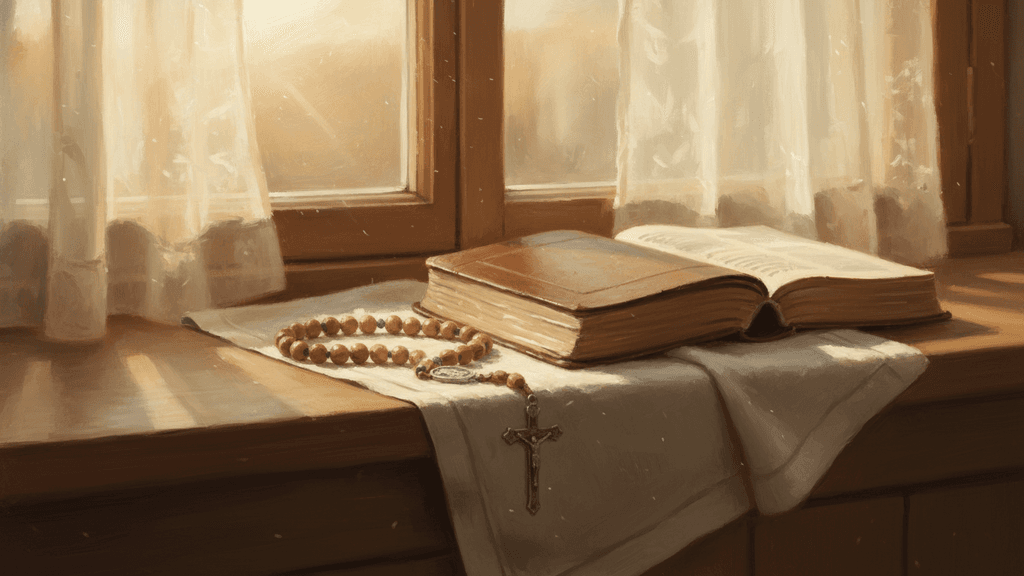
The Morning Offering is the single shortest prayer in the Catholic tradition that can change the meaning of an entire day. In about thirty seconds, you consecrate every thought, word, work, joy, and suffering of the coming hours to the Sacred Heart of Jesus — turning ordinary tasks into prayer without adding anything to your schedule.
Key Takeaways
- The Morning Offering is a 30-second Catholic prayer that consecrates the whole day to the Sacred Heart of Jesus through Mary
- It originated with the founding of the Apostleship of Prayer in 1844 and is now associated with the Pope's monthly intentions
- Praying it makes ordinary work — meetings, errands, parenting, traffic — count as prayer in union with the Mass
- The Enchiridion of Indulgences grants a partial indulgence each time it is devoutly prayed
- Anchor it to the first thirty seconds after waking and you will rarely miss it
- Listen to the Morning Offering on Ave Audio and pray along while you make coffee or get ready
If you have heard the prayer before but never quite understood what you were doing when you said it, this guide is for you. Below is the full traditional text, the history behind every line, the theology of "offering up" your day, and a practical method for making it a habit you actually keep.
The Full Text of the Morning Offering
This is the traditional form approved by the Apostleship of Prayer and used in most American Catholic prayer books:
O Jesus, through the Immaculate Heart of Mary, I offer You my prayers, works, joys, and sufferings of this day, in union with the Holy Sacrifice of the Mass throughout the world.
I offer them for all the intentions of Your Sacred Heart: the salvation of souls, reparation for sin, and the reunion of all Christians.
I offer them for the intentions of our bishops and of all Apostles of Prayer, and in particular for those recommended by our Holy Father this month. Amen.
Several shorter forms exist — see the FAQ at the bottom of this post — but the version above is the one most commonly memorized and the one the Apostleship of Prayer (now called the Pope's Worldwide Prayer Network) has used for nearly two centuries.
Where the Morning Offering Comes From
The prayer in its current form dates to December 3, 1844, when a French Jesuit named Fr. Francis-Xavier Gautrelet founded the Apostleship of Prayer at the seminary of Vals, near Le Puy. His seminarians were frustrated because they were not yet missionaries — they could not go preach the Gospel. Fr. Gautrelet's solution was theological: you do not have to go anywhere. Every prayer, every act of study, every fatigue of the day could be offered for the missions and the conversion of souls.
The Morning Offering grew out of that insight. By the 1860s, Pope Pius IX had encouraged it formally; by the early 20th century, it was a fixture of Catholic life, particularly through the family prayer movement and the Sacred Heart devotion popularized after the apparitions to St. Margaret Mary Alacoque at Paray-le-Monial.
In 2014, Pope Francis renamed the Apostleship of Prayer to the Pope's Worldwide Prayer Network and gave it a new mission: to spread the Pope's monthly prayer intentions globally. When you pray the Morning Offering today, the final line — "in particular for those recommended by our Holy Father this month" — connects your day to that worldwide intention, whatever it is for the current month.
What "Offering Up" Actually Means
The phrase "offer it up" is one of the most quietly misunderstood expressions in Catholic spirituality. Many Catholics grew up hearing it as a way of being told to stop complaining. That is not what it means.
To offer up a moment — your morning headache, your difficult coworker, your loneliness, your effort to be patient with your toddler — is to consciously join that moment to the suffering and love of Christ on the Cross, made present again at every Mass. St. Paul writes that he "completes what is lacking in the afflictions of Christ" (Colossians 1:24). Catholic tradition has always understood this not as Christ's redemption being insufficient, but as a real invitation: he chose to leave room in his work for ours.
The Morning Offering is the formal Catholic act of doing exactly that — at the beginning of the day, before any of the day's joys or pains have happened, before you know whether the day will be easy or hard. You hand the whole thing over in advance.
This is why a Catholic who prays the Morning Offering is, in a real sense, praying all day long. Stuck in traffic for forty minutes? You already offered it. A difficult conversation with your teenager? Already offered. Slept badly and dragged through the morning? Already offered. The prayer does not erase the difficulty, but it transfigures it. The exhaustion still tires you; it just no longer goes to waste.
A Line-by-Line Reading
Each line of the prayer is doing specific theological work. Knowing what each phrase means makes the prayer feel less like a recitation and more like the small, deliberate act of consecration it is.
"O Jesus, through the Immaculate Heart of Mary"
The prayer is directed to Jesus and offered through Mary. This is the classic Catholic pattern: Ad Iesum per Mariam — "To Jesus through Mary," the spiritual axiom of St. Louis de Montfort. Mary purifies and presents what we cannot present perfectly ourselves. A child gives a parent a crumpled paper drawing; the other parent receives it as a treasure. That is, more or less, the dynamic the line invokes.
"I offer You my prayers, works, joys, and sufferings of this day"
Four categories that, between them, cover almost everything that will happen to you. Prayers — your set prayers and your interior turning toward God. Works — your job, your housework, your study. Joys — the small pleasures of food, friendship, beauty. Sufferings — the inevitable frictions, large and small. Nothing is excluded. Even the joys are offered, because joy that is offered is doubled.
"in union with the Holy Sacrifice of the Mass throughout the world"
This is the line most Catholics rush past, and it may be the most important. At every moment, somewhere on earth, the Mass is being offered — the Mass is not a series of separate events but a single continuous sacrifice that happens to break the surface of time at thousands of altars per day. Your morning prayer is grafted onto that. You are not praying alone; you are praying inside the Mass.
"for all the intentions of Your Sacred Heart"
The Sacred Heart devotion teaches that Jesus has specific present desires: the salvation of souls, reparation for sin, and the reunion of all Christians. Your day is offered for those purposes whether or not you feel a direct connection to them. The classical Sacred Heart devotion explains this in more detail.
"for the intentions of our bishops and of all Apostles of Prayer"
You join your offering to the worldwide network of Catholics doing the same thing. There are millions of Catholics, religious communities, schools, hospitals, and lay associations praying this same prayer each morning. The offering is communal even when you say it alone.
"and in particular for those recommended by our Holy Father this month"
The current month's Pope's intention is the specific target of your day's offering. You can find each month's intention at the Pope's Prayer Network site or in any Catholic monthly missal.
How to Make the Morning Offering a Daily Habit
The Morning Offering is theologically heavy but practically light: it takes thirty seconds. The challenge is not difficulty — it is consistency. Here is the structure that actually works for most Catholics.
Anchor it to a physical moment. Pick something you already do every morning and bolt the prayer onto it. The most common anchors:
- When your feet first touch the floor
- While the coffee maker runs
- While you brush your teeth
- The moment you sit in the car before starting the engine
Anchoring beats willpower every time. Habits attached to existing routines survive; floating intentions disappear.
Use audio for the first three weeks. Reading the prayer from memory imperfectly is fine — but during the learning period, hearing it spoken slowly and reverently fixes both the words and the meaning. Listen to the Morning Offering on Ave Audio and pray along while you do your first morning task. After three weeks, you will know it cold.
Pair it with the Sign of the Cross and a brief examination of intention. The full morning anchor is:
- Sign of the Cross
- Morning Offering
- One sentence: "Lord, what do you need from me today?"
Total time: under one minute. That is a complete Catholic morning prayer practice, and it is the entry point to the broader daily prayer routine most Catholics aim for over time.
Do not rebuild from zero after you miss a day. Habit formation research is unanimous on this — single misses do not break habits, but treating a single miss as failure does. Miss Tuesday? Pray it Wednesday. Move on.
Shorter Forms of the Morning Offering
Several religious orders and lay communities use abbreviated versions. These are perfectly licit and may be easier to memorize for children or for adults at the start of building the habit.
The shortest traditional form (often called the Apostleship Brief Offering):
Jesus, through the Immaculate Heart of Mary, I offer You my prayers, works, joys, and sufferings of this day, for all the intentions of Your Sacred Heart.
The St. Therese form (used in many Carmelite communities):
O my God, I offer You this day all my thoughts, words, actions, and sufferings, in union with the Heart of Jesus Christ Your Son. Amen.
The classic children's form (often the first Catholic prayer learned after the Our Father and Hail Mary):
O Jesus, I give You today all I think, say, and do, in union with Your love for the Father and for me.
Choose the form you will actually say. A short prayer prayed daily is infinitely more valuable than a perfect prayer left unsaid.
When the Day Goes Sideways
There will be days when the Morning Offering feels mechanical, days when you forget it entirely, and days when something so heavy happens by 9 a.m. that the prayer feels almost insulting in its small scope.
For mechanical days: keep praying it anyway. Faithfulness in dryness is one of the older and harder Catholic disciplines. St. Teresa of Ávila and St. Therese of Lisieux both wrote about this — the worth of the prayer comes from your intention to pray, not from the warmth of the feeling.
For forgotten days: pray it whenever you remember, even if it is bedtime. The Church does not bind the prayer to a clock.
For heavy days: notice that the prayer specifically includes sufferings. It was designed for exactly the days that feel too hard. The early Apostleship of Prayer literature spoke of "the morning offering meeting the noon disaster" — that is not a bug; that is the point.
If a day's suffering feels too overwhelming to offer through a memorized prayer, you can also turn to one of the Church's prayers in difficult times. The prayers for the sick and suffering on Ave Audio include several intercessions designed for exactly such moments.
Why the Morning Offering Belongs in Your Daily Prayer Life
Most Catholic prayer practices — the Rosary, the Liturgy of the Hours, Eucharistic adoration, the Examen — require time, place, and attention. The Morning Offering requires none of those. It fits inside any vocation, any schedule, and any state of life. A monk and a single mother of four can pray the same prayer on the same morning, and both have started their day in essentially the same way: by handing it over.
That is the genius of the prayer. It is the prayer that costs nothing and means everything. It transforms work that would have happened anyway into prayer that would not have. It joins your unremarkable Tuesday morning to the Mass, to the Pope's intention for the month, to the Sacred Heart of Jesus, and to every other Catholic on earth who began their day the same way.
New to Ave Audio? You receive 60 free credits when you create an account — more than enough to listen to dozens of Catholic prayers at no cost. Start with the Morning Offering and build your morning anchor from there.
Frequently Asked Questions
What is the Catholic Morning Offering prayer? The Morning Offering is a short Catholic prayer said upon waking that consecrates the day — every prayer, work, joy, and suffering — to the Sacred Heart of Jesus through the Immaculate Heart of Mary. It dates to the 1844 founding of the Apostleship of Prayer (now the Pope's Worldwide Prayer Network) and is offered for the monthly intentions of the Pope.
What is the exact text of the Morning Offering? The traditional text is: "O Jesus, through the Immaculate Heart of Mary, I offer You my prayers, works, joys, and sufferings of this day, in union with the Holy Sacrifice of the Mass throughout the world. I offer them for all the intentions of Your Sacred Heart: the salvation of souls, reparation for sin, and the reunion of all Christians. I offer them for the intentions of our bishops and of all Apostles of Prayer, and in particular for those recommended by our Holy Father this month. Amen."
When should I say the Morning Offering? Pray it as soon as possible after waking — ideally before checking your phone, before coffee, before conversation. The whole point is to offer the day before the day begins. Many Catholics tie it to a physical anchor: the moment their feet touch the floor, or while making the Sign of the Cross at the bedside.
Why does the Morning Offering mention the Sacred Heart and the Immaculate Heart? The prayer reflects the Catholic devotion to the Sacred Heart of Jesus, popularized after the visions given to St. Margaret Mary Alacoque in the 1670s. We offer the day "through the Immaculate Heart of Mary" because the Church has always understood Mary as the surest path to her Son — she presents our small offerings purified by her own perfect love.
Do I get an indulgence for praying the Morning Offering? Yes. The Enchiridion of Indulgences grants a partial indulgence to the faithful who devoutly offer their work to God at the beginning of the day. Combining the Morning Offering with the day's monthly papal intention has been encouraged by every Pope from Pius IX through Pope Francis.
What if I forget to pray it in the morning? Pray it whenever you remember — the Church does not measure prayer by exact timing. A Morning Offering said at 11 a.m. still consecrates the rest of the day. If you remember in the evening, pray it then for tomorrow. The habit matters more than the hour.
Are there shorter versions of the Morning Offering? Yes. The simplest is: "O my God, I offer You this day all my thoughts, words, and actions, through Jesus Christ our Lord. Amen." Many religious communities also use the brief Apostleship of Prayer form above.
Listen to the prayers in this guide
Hear Your Prayers Come Alive
Ave Audio turns prayer text into beautiful audio with premium AI voices. Start with 60 free credits — no credit card required.